ARTICLES
There is no shortage of articles claiming that AI will transform HR and payroll. Most focus on what AI can do.I think the more useful question is different: which technology is best suited for which type of work?Not every problem is an AI problem. Sometimes a Large Language Model (LLM) is the right tool. Sometimes a deterministic rule engine is exactly what you need. Sometimes an AI agent can combine both. And sometimes the right answer is simply that a person must make the decision.Understanding these boundaries is becoming just as important as understanding AI itself.
1. Where LLMs shine
Large Language Models are exceptional at working with language. They can read lengthy documentation, explain regulations in plain language, compare policy documents, summarise legislation, draft communications, analyse unusual situations and help investigate problems.In HR, this might include:
- explaining a complex payroll rule
- interpreting a collective labour agreement
- comparing policy changes
- drafting employee communications
- investigating why a payroll result looks unusual
The common thread is interpretation. LLMs are remarkably good at understanding messy, unstructured information and turning it into something useful.What they do not provide is deterministic computation. I tested this directly. I asked the same commercial LLM the same simple question five times, each time in a fresh conversation. I received five different explanations. None was obviously wrong, and a specialist would probably accept all of them, but none was the same.This is not a temperature setting that can be turned down. It is what these models are built to do: generate plausible language, not reproduce the one canonical answer an auditor or payroll specialist would treat as definitive.For many tasks, that variation is perfectly acceptable. For calculating someone's salary, it is not.
2. Where rule-based systems remain the right tool
Payroll is fundamentally a calculation engine. Tax calculations, pension contributions, social insurance, absence processing and statutory deductions all depend on applying well-defined rules consistently.Given the same inputs, the output should always be identical. That is exactly what deterministic software is designed to do.This is why modern payroll systems have spent decades building sophisticated rule engines. They may not be glamorous, but they provide something that regulated environments depend on:
- reproducibility
- auditability
- traceability
- predictable outcomes
Ironically, one of AI's greatest strengths, its flexibility, is precisely what makes it unsuitable for the core calculation itself. The objective should not be to replace deterministic systems. It should be to recognise when they are the right tool.
3. Where agentic AI fits
Agentic AI is often presented as the next evolution beyond LLMs. I think it is better understood as an orchestration layer. An agent combines an LLM's ability to reason with the ability to interact with other systems.Imagine a payroll investigation. An agent could retrieve information from several HR systems, read relevant policies, compare payroll periods, identify anomalies, prepare a summary and recommend where someone should investigate further.This is where agentic AI becomes genuinely valuable. The LLM provides the reasoning. The deterministic systems provide the calculations and business rules. The agent coordinates the workflow. Used this way, the technologies complement rather than compete with each other.As the actions become more consequential, processing payroll, submitting statutory filings or initiating payments, the need for guardrails, validation and human review becomes increasingly important.
4. Where AI should not be the decision-maker
The final category is not really about technical capability. It is about accountability.It helps to distinguish between deterministic processing and decision-making. Running payroll through a rule-based engine is a calculation. Using AI to influence outcomes that affect employees, for example by analysing absence patterns, prioritising investigations or recommending actions, is a different category. The closer AI gets to decisions about people, the greater the need for human oversight.Some responsibilities carry legal, financial or ethical consequences that should not simply be delegated to an AI system. Examples include:
- approving payroll before payment
- making exceptions that require professional judgement
- accepting responsibility for statutory reporting
- making decisions that materially affect employees
AI can analyse. AI can explain. AI can recommend. But accountability still belongs to people.This is no longer only a matter of good practice. In the European Union, it is increasingly becoming a legal expectation. Under the AI Act, many AI systems used in employment-related decisions may fall into the high-risk category and are expected to include meaningful human oversight. In other words, the direction is clear: for many consequential AI-assisted decisions, systems must be designed so that people can understand, monitor and intervene.Perhaps the most important point is that accountability cannot be outsourced. Even when an organisation uses third-party AI solutions, responsibility for how those systems are deployed remains with the organisation itself. The practical consequence is straightforward: design AI-assisted workflows with clear review and approval points, so that people remain in control whenever meaningful judgement is required.The regulatory details will continue to evolve. The underlying direction, however, is already clear: for decisions with significant consequences for people, human oversight is becoming the norm rather than the exception.
The architecture matters more than the technology
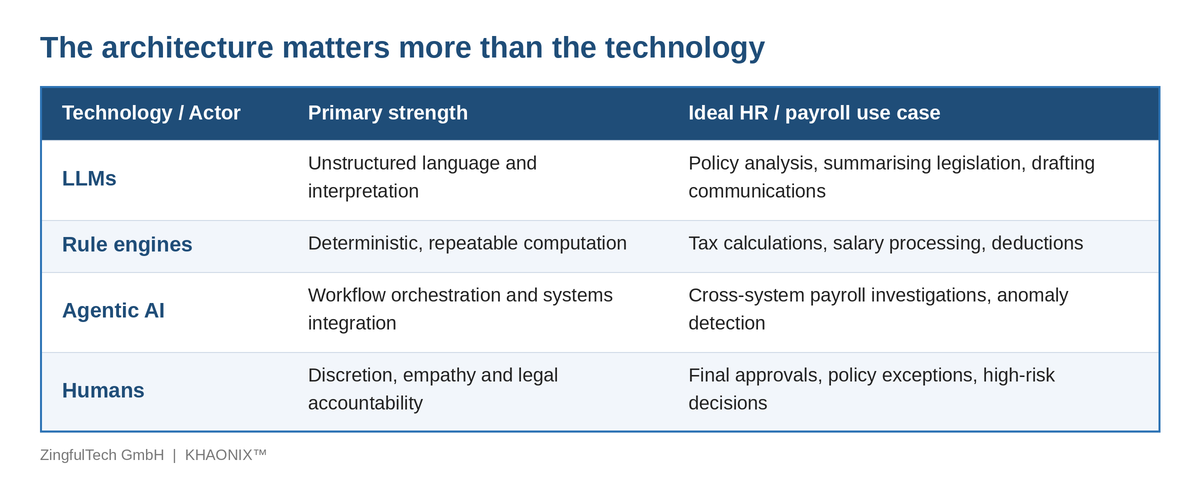
One thing stands out to me after following the rapid progress of AI over the past few years. The future probably does not belong to one technology replacing all the others. It belongs to architectures that combine them effectively.● LLMs are excellent at understanding language.● Rule-based systems excel at deterministic computation.● Agentic AI can coordinate increasingly complex workflows.● Humans remain responsible where judgement and accountability matter.The organisations that benefit most from AI are unlikely to be those replacing every process with a language model. They will be the ones combining each technology where it is strongest, and recognising where the boundaries should remain.Especially in regulated domains like HR and payroll, good system design is becoming less about choosing between AI and traditional software, and more about knowing exactly where each belongs.
06.07.2026