
Migrating systems, running parallel, comparing periods or auditing a payroll run? PayrollCompare AI compares your documents field by field and tells you exactly what is the same, what changed, and what is missing. No system access, no configuration. You run your documents through it and read the result.
Powered by the Khaonix platform.
Need your company-specific wage types recognised?
Contact me to scope a client-specific model: kees@khaonix.ai
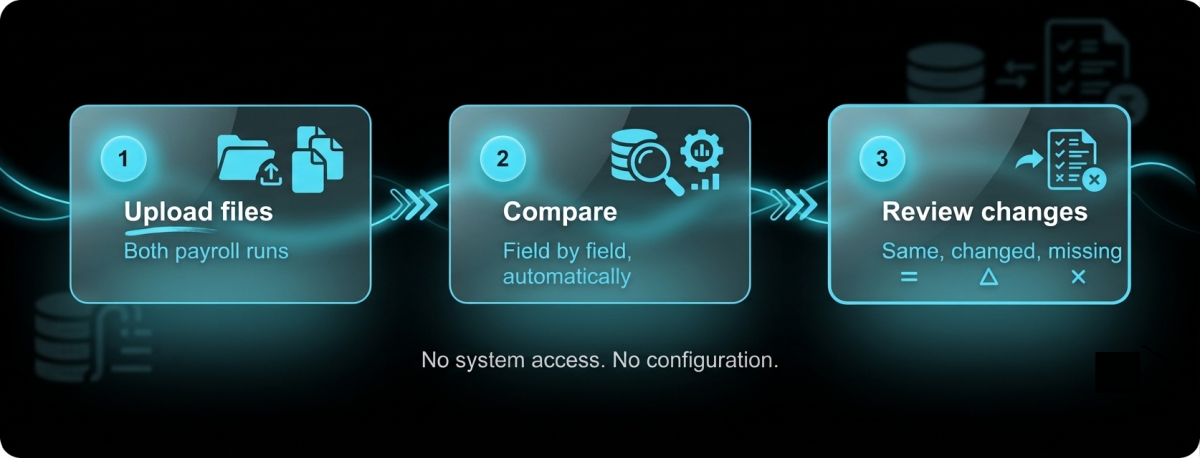
When two payroll systems should agree, for example in a migration, a parallel run or an audit, confirming they actually do is slow, manual work. You export from both sides, line them up, normalise formats that do not match, compare value by value, chase down every difference, and repeat it for the next pay run. PayrollCompare AI replaces that with three steps:
- Upload file
- Compare
- Review changes
Built differently
- Bounded by design. The model reads exactly the payroll fields it was specified to read, and nothing beyond. Its limits are known before it ships, not discovered in production.
- Trained without your data. The model learns entirely from synthetic data, manufactured for the purpose. Your documents are read to produce your result, then discarded.
- Specified, not assumed. You tell the system which payroll items your company uses. It works backwards from that specification instead of guessing from your documents.
This is the Khaonix platform. PayrollCompare AI is the first product built on it. Read how the method works.
Also available as an API
Underneath PayrollCompare AI sits the same capability as a building block: structured payroll fields extracted from any payslip, returned as data. If you are building your own workflow, an integration, or an AI pipeline that needs reliable payroll data from documents, the extraction API is the piece that reads them. It returns exactly the fields it was specified to read, as structured data, and nothing beyond. Contact me: kees@khaonix.ai
PayrollCompare AI is the first product built on the Khaonix platform: a system that manufactures bounded document models from a specification, without ever training on real documents. Payroll is the first proof the machinery runs end to end, not the limit of what it is for.