
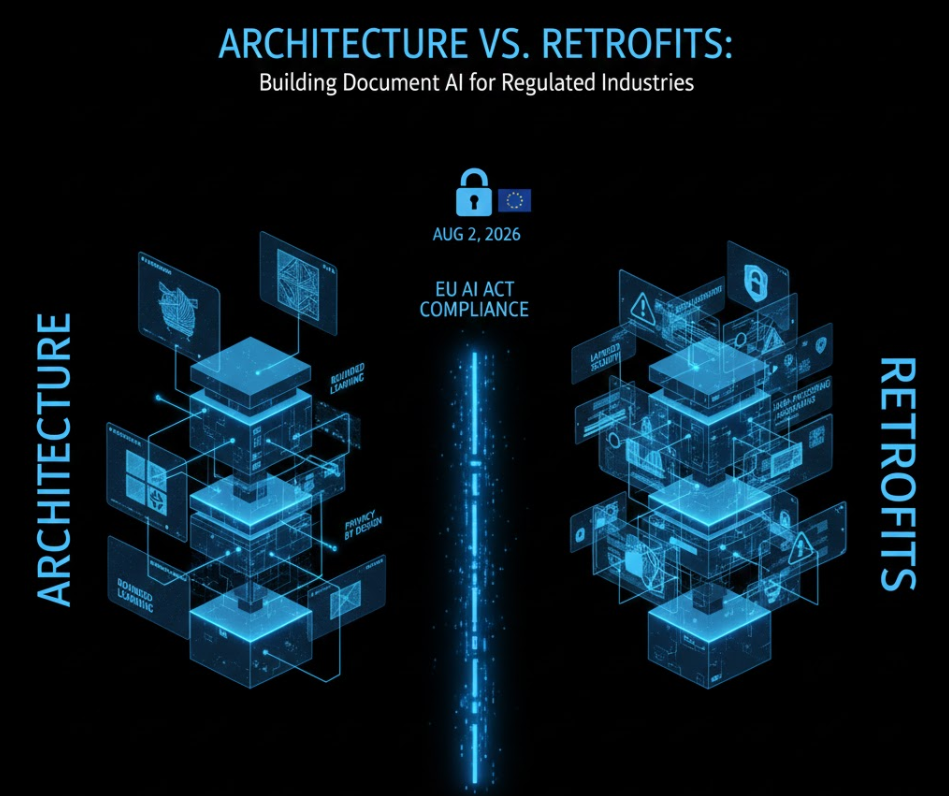
Architecture vs. Retrofits: Building Document AI for Regulated Industries
In six months, on August 2, 2026, the EU AI Act’s requirements for high-risk AI systems take full effect. Across regulated industries, procurement teams are already adding a new line to vendor questionnaires:
“How does your AI system comply with the EU AI Act?”
For many AI vendors working with sensitive documents, this is an uncomfortable question. The answer typically involves lengthy explanations about data-processing agreements, anonymization measures, human-oversight concepts, and compliance roadmaps that may never fully address the architectural challenge.
The issue is not documentation.
It’s architecture.
It’s architecture.
We built Khaonix to answer that question differently: with a document AI platform designed for regulated environments from the beginning. Here’s why that distinction matters and what it changes for enterprises operating under strict compliance constraints.
The fundamental problem with traditional document AI
Consider the documents that underpin critical business operations: payroll records, financial statements, medical files, legal contracts, insurance claims. These documents contain precisely the types of personal and sensitive data that GDPR and the EU AI Act are designed to protect.
For task-specific document AI, systems that must reliably extract, verify, or reconcile structured information, traditional machine learning still depends on large volumes of real documents. That creates a fundamental tension:
You need sensitive data to train the system, but using sensitive data to train the system introduces significant privacy, compliance, and governance risk.
Most vendors attempt to manage this tension through data-processing agreements, anonymization pipelines, restricted environments, and layered security controls. While necessary, these measures are ultimately retrofits: compliance safeguards added on top of architectures that were never designed for regulated use cases in the first place.
As regulatory scrutiny increases, these retrofits are becoming harder to defend.
A platform approach: privacy by design
Khaonix takes a fundamentally different approach. Our platform does not train on real documents at all.
Instead, it is built on a proprietary methodology that uses synthetic documents: artificially generated inputs that contain no real personal or sensitive information designed to replicate the structural patterns and edge cases found in production documents. This is not about generating “fake data” and hoping the model generalizes. It is an architectural framework we call bounded learning.
Bounded learning deliberately constrains what the AI is allowed to learn. Rather than attempting to interpret every possible variation of a document, the system is focused on the specific elements required for a defined verification or analysis task.
This intentional limitation delivers three critical outcomes:
- Privacy risk is eliminated by design
No real personal data is used during training. This removes data-retention concerns, breach exposure during development, and dependency on access to sensitive datasets. - Accuracy improves where it matters
A constrained scope allows the model to perform more reliably on the specific fields and relationships that are relevant to the task, rather than spreading capacity across irrelevant variation. - Regulatory alignment is built in
Applications are designed as professional support and verification tools, with clear task boundaries and human oversight, supporting risk-appropriate classification under the EU AI Act.
Payroll as proof: where regulation meets reality
Payroll is a clear example of where this approach matters. Payslips contain names, salaries, tax identifiers, and bank details: some of the most sensitive personal data organizations process. Under the EU AI Act, AI systems that influence employment-related decisions are classified as high-risk, triggering extensive compliance obligations.
PayrollCompare AI, the first application built on the Khaonix platform, applies the bounded learning framework to a concrete, high-value problem: comparing payroll outputs across periods and systems to identify discrepancies during parallel runs, audits, and consolidation.
By design:
- Model training uses only synthetic payslips
- The system supports verification and quality-control workflows
- No automated decisions about individuals are made
- Human oversight is integral to the process
- The tool operates independently of payroll system configuration
For procurement and risk teams, this enables a clear and defensible answer: the system supports human review, does not rely on real personal data for training, and is designed with regulatory boundaries in mind.
Beyond payroll: a platform for regulated documents
The same architectural principles apply across other regulated domains:
- Financial services: statement reconciliation, contract analysis, audit preparation
- Healthcare: document verification, claims support, structured record analysis
- Legal: contract review, due diligence, compliance monitoring
- Insurance: claims comparison, policy analysis, underwriting support
In each case, the documents that most benefit from AI assistance are also the ones subject to the highest regulatory expectations. Architecture-first design resolves this tension.
The shift to compliance-native AI
Regulated industries are not waiting for more powerful AI. They are waiting for AI that works within their constraints.
Not systems that add compliance as an afterthought, but platforms designed from the ground up to respect privacy, define scope explicitly, and enhance, rather than replace, human judgment.
As the August 2026 deadline approaches, enterprises face a clear choice. They can partner with vendors attempting to retrofit compliance onto existing architectures, or they can adopt platforms built specifically for regulated environments.
Khaonix was built for organizations choosing the latter path.
4 February 2026