
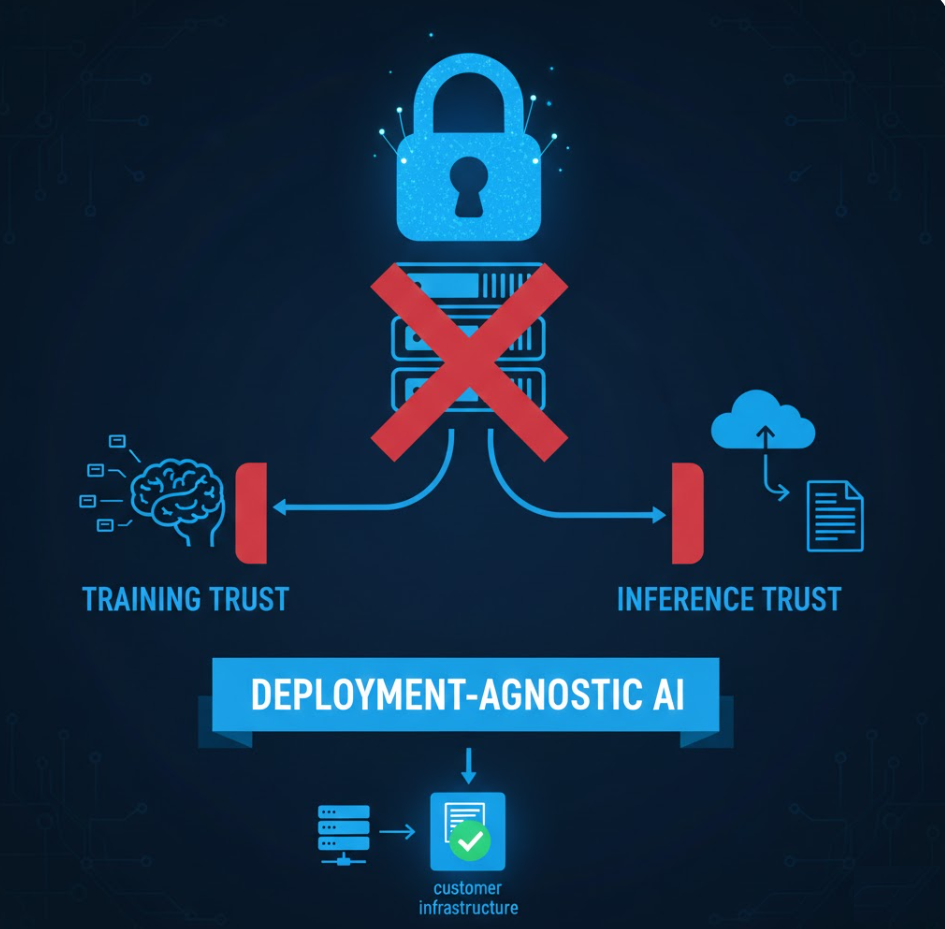
The complete trust problem
to
“Where should this run?”
A healthcare company wants to use AI for document processing.
The compliance team asks one question:
“Where does our data go?”
The vendor answers:
“To our servers, for processing and for continuously improving our models.”
Deal dead.
This scenario plays out every day in regulated industries. But what’s often missed is that compliance teams are not asking a single question. They’re asking two, whether explicitly or not.
Question 1: Will you train your models on our sensitive data?
This is the training trust problem. Organizations in healthcare, finance, and other regulated sectors cannot simply hand over years of sensitive documents for model training, even with strong encryption and access controls.
This is the training trust problem. Organizations in healthcare, finance, and other regulated sectors cannot simply hand over years of sensitive documents for model training, even with strong encryption and access controls.
Question 2: Will our sensitive data leave our infrastructure during actual use?
This is the inference trust problem. Even if training happens elsewhere, routing documents through a vendor’s infrastructure during operation creates ongoing compliance risk and loss of control.
This is the inference trust problem. Even if training happens elsewhere, routing documents through a vendor’s infrastructure during operation creates ongoing compliance risk and loss of control.
Most discussions about AI in regulated industries focus on the first question. But solving training trust alone does not answer where data goes every time the system is used.
When I started building Khaonix, a document AI platform for regulated industries, it became clear that both problems had to be solved, and that solving one would need to enable the other.
Some vendors allow customers to opt out of model improvement. But even then, documents still need to flow through vendor-controlled infrastructure during processing. This means data control and deployment remain architectural questions, not contractual ones.
Why most AI vendors can’t solve both
Traditional machine learning creates an architectural constraint most vendors can't escape.
Machine Learning models need large volumes of real data to achieve good performance. For document AI, that means thousands of actual invoices, payslips, or medical records. But the dependency doesn't stop at initial training. These models require continuous access to production data for retraining, feedback loops from real usage to improve accuracy, and aggregated data across customers to maximize quality.
This creates an architectural requirement for centralized, vendor-controlled infrastructure. Vendors need multi-tenant SaaS deployment because they need ongoing access to customer data flowing through the system.
When vendors offer "on-premise deployment," it typically means accepting compromises: degraded model performance (trained only on your limited data), prohibitive costs (custom training from scratch), or ongoing dependency (model quality degrades without vendor updates).
The vendor isn't being difficult but they're constrained by their architecture. Their training approach requires data access, which requires a specific deployment model.
A different architectural starting point
Khaonix was designed around a different assumption: effective models should not require access to real sensitive data.
This led to what we call a bounded learning framework, where models are trained on synthetic documents rather than real ones.
Synthetic documents are generated to capture structural, regulatory, and system-specific patterns relevant to a given document type, without containing any real personal or sensitive information.
The synthetic data represents the problem space accurately enough to train effective models, without introducing privacy, governance, or data-retention risk.
Why this matters beyond training
Here’s the key insight: when training no longer depends on customer data, deployment no longer needs to preserve data access.
Traditional vendors require centralized deployment not only to process documents, but to maintain feedback loops for model improvement. With bounded learning, once a model is trained, it can operate without relying on production data.
What “deployment-agnostic” actually means
Because Khaonix does not require ongoing access to customer data for training or model improvement, different deployment models become genuinely viable, without architectural compromise:
- Multi-tenant SaaS
Standard enterprise security controls, minimal operational overhead - Private cloud deployment
Running entirely within a customer’s own AWS, Azure, or GCP environment - Dedicated or isolated infrastructure
For air-gapped or ultra-sensitive environments
Traditional “on-prem” offerings often sacrifice model quality, require vendor connectivity, or freeze models over time. With bounded learning, deployment is determined by security and compliance requirements, not by technical dependencies.
Customization becomes viable
Solving both training and inference trust unlocks another consequence: economic customization.
Traditional machine learning struggles with custom models because individual organizations rarely have enough historical data to train them effectively, and the cost of bespoke training is high.
With synthetic data generation, customization becomes a configuration problem. Training data can be generated to reflect specific systems, jurisdictions, regulatory contexts, or internal policies, without relying on years of real documents.
This creates two independent dimensions:
- deployment environment
- model customization
Why this isn’t security theater
A reasonable question: "Couldn't any AI vendor become more secure with better encryption and access controls?"
Not really. Better security controls are valuable, but they don't address the fundamental architectural constraint: traditional ML requires ongoing access to real data, which determines possible deployment models. This isn't about bolting security onto existing architecture. It's about different design choices from the foundation.
When auditors ask "How is this AI trained?" and "Where does our data go during processing?", the answers fundamentally differ:
- Training trust
Traditional: “Trust us with your data while we train.”
Bounded learning: “We don’t need your data.” - Inference trust
Traditional: “Your data must flow through our infrastructure.”
Deployment-agnostic: “Run it where you need.” - Ongoing dependency
Traditional: “We need your data to maintain quality.”
Bounded learning: “Model quality is independent of production data.”
Applicability across regulated domains
The bounded learning approach is intended for document types where:
- real training data is scarce due to privacy constraints
- compliance and explainability are essential
- trust and accuracy determine adoption
The same principles apply to healthcare records, financial statements, legal contracts, insurance documentation, and other regulated documents.
Payroll illustrates the approach, but it does not define its limits.
Conclusion Trust in regulated AI has two dimensions: training and inference. Most approaches address neither fully or focus only on training while ignoring where data flows during actual use.
Bounded learning solves training trust through synthetic data. More importantly, it enables deployment agnosticism, allowing data to remain in customer-controlled environments.
That shifts the conversation from
“Can we trust you with our data?”
“Can we trust you with our data?”
to
“Where should this run?”
That's not marketing language. It's what becomes possible when architectural choices are made with regulated environments in mind from the start.
10 February 2026