
Five questions every payroll professional should ask before trusting AI with compliance work
Imagine a payroll manager posts in an online forum. They've just used a general-purpose AI tool to complete a month-end validation that normally takes three hours. It took two minutes. They're impressed, a little unsettled, and wondering whether others are doing the same.
It's a reasonable reaction. The capability is real. But the post raises a question that nobody in that thread is asking: should a compliance-sensitive process like payroll validation be handed to an AI tool without understanding what that tool actually is?
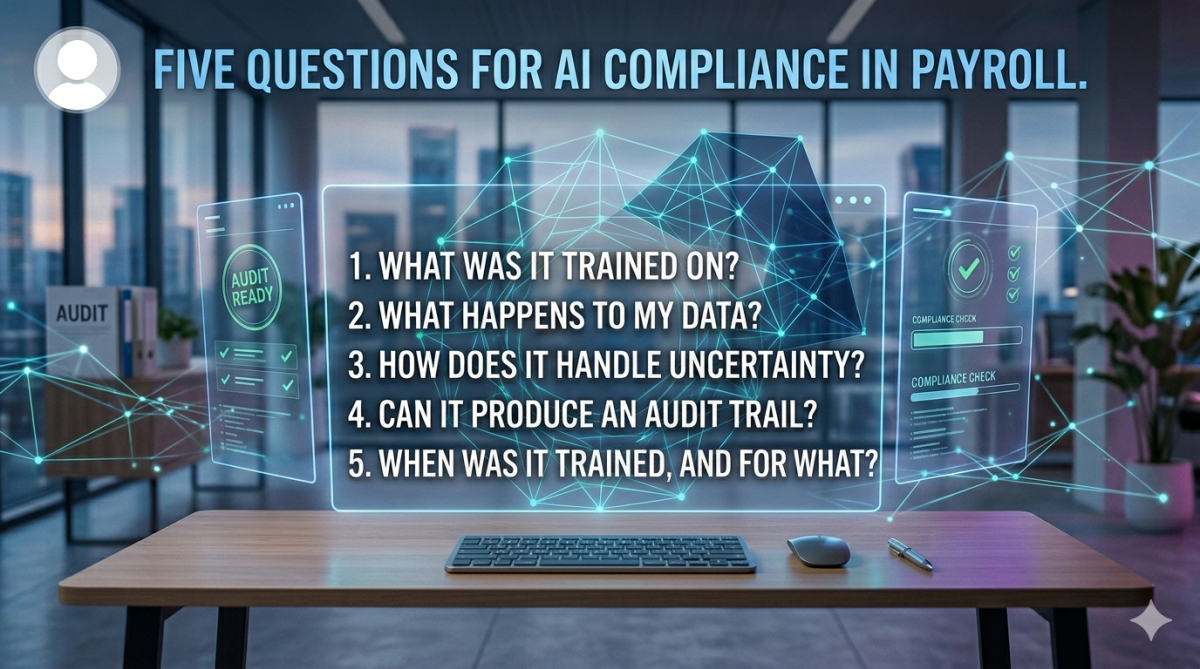
Payroll is audit-aware by instinct: checking, double-checking, 4-eye checks, 10% checks etc. Payroll professionals document and they ask for evidence. It's time to apply the same discipline to the AI tools being rolled out across our organisations. Here are five questions worth asking before you allow AI into payroll processes.
1. What was it trained on, and whose data was used?
Most general AI tools are trained on large volumes of text and documents from across the internet. Some agentic payroll tools are trained on real payroll data from real organisations. Either way, the question matters: if a model learned from sensitive payroll documents, whose were they, and did those people consent to that use? For compliance teams navigating GDPR and data residency requirements, this is not a theoretical concern.
2. What happens to my data when I use it?
Submitting a gross-to-net report to an AI tool is a data transfer. Where does it go? Who can see it? Is it retained after the session? Is it used to train future versions of the model? Cloud-based AI tools often process data on infrastructure outside your jurisdiction. That matters. "Data never leaves your network" is a procurement-grade claim. "We take data seriously" is not.
3. How does it handle uncertainty and errors?
When an AI tool produces an output, does it tell you how confident it is? Does it flag the cases it is less certain about, or does it present everything with equal confidence? A tool that cannot communicate its own uncertainty is not ready for compliance use, regardless of how impressive the demo looks.
4. Can it produce an audit trail?
If a regulator or auditor asks how a payroll calculation was validated, "the AI checked it" is not a sufficient answer. Can the tool show its working? Can it produce a structured, reviewable output that a human can stand behind? Auditability is not a feature. It is a requirement.
5. What exactly was it trained for, and when?
A general AI tool is trained for everything, which means it is optimised for nothing in particular. Payroll is a narrow, jurisdiction-specific domain. Social security rates change. Tax thresholds change. Statutory leave calculations change A model that was built on data up to a certain date is silently wrong about everything that changed after that date, with no way to flag it. Any AI tool applied to payroll work should be able to tell you precisely what it was built to do, in which jurisdictions, and how current its underlying knowledge is.
Payroll is adopting AI. It should. The efficiency gains are real and the administrative burden is genuine. But adoption without interrogation is how compliance failures happen.
These five questions are a starting point.
29 March 2026