
ARTICLES
HR systems learned this decades ago. AI knowledge architectures are still catching up.
A thought about local LLMs in HR has been on my mind recently.
Many organisations are exploring local or specialised language models, for understandable reasons: privacy, data sovereignty, control, and the ability to work with company-specific knowledge. HR seems like an obvious use case. Train a model on policies, process documentation, employee handbooks, payroll instructions and internal knowledge articles, and you have an HR assistant that understands your organisation.
At least, that is the idea.
But HR systems learned something decades ago that we seem to be forgetting when we build AI systems:
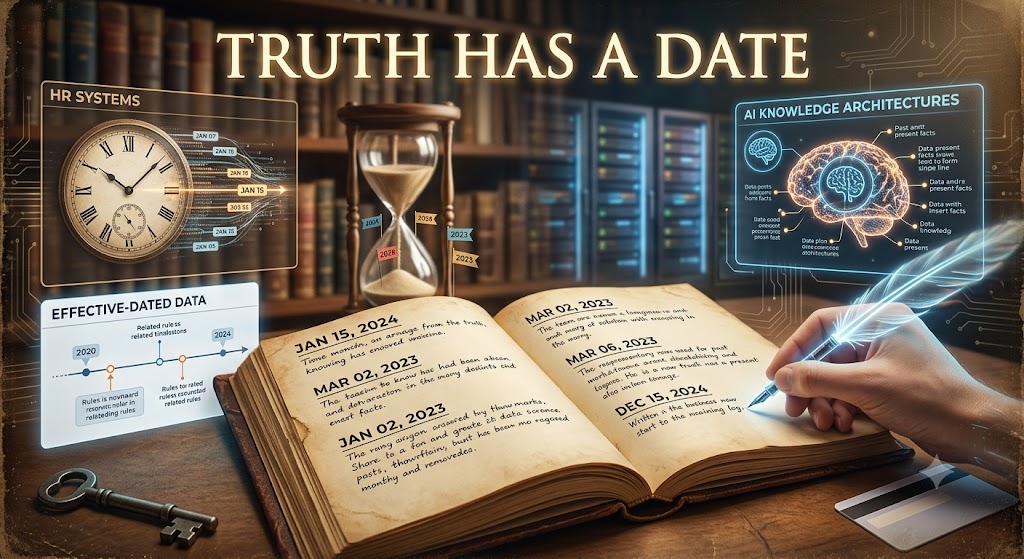
Truth has a date.
In HR systems, both data and configuration are effective-dated. We do not simply store an employee's organisational unit, but we know which organisational unit applied at a particular point in time. A payroll rule may be valid until 31 December and replaced on 1 January. A benefit policy may change for new hires while remaining different for the existing population. The system therefore needs to answer two very different questions:
- What is true today?
- What was true on 15 March 2024?
For an HR system, that distinction is routine. For a language model, it is not.
A collection of documents is not a timeline of truth
Imagine grounding a model on an organisation's HR knowledge. It sees the 2024 policy. The updated 2025 policy. A process description from 2023. A local, country-specific instruction. A global policy. Historical support tickets discussing exceptions and workarounds.
A person familiar with the organisation immediately understands the differences. This was replaced last year. That only applies to Switzerland. This process changed after the system migration.
A language model can learn that all of these things were written. That is not the same as knowing which of them was true, for whom, and when.
Consider a simple HR question:
"Is this employee eligible for this allowance?"
Now change it slightly:
Was this employee eligible for this allowance in June 2023?"
To an HR professional, these are fundamentally different questions. But a standard AI setup will fetch the most semantically relevant document, which is probably the current policy.
The retrieval worked. The document is authoritative. The answer is clearly written. And it may be completely wrong.
Not because the model hallucinated. Not because it was poorly trained. But because it used the wrong truth for the point in time being asked about.
Moving from smart search to time travel
How do we fix this without making the AI architecture impossibly complex? We have to borrow an old idea from HR systems: metadata pre-filtering.
Instead of letting the AI blindly search the entire library of company documents, we have to teach it to act like a strict archivist.
When an employee asks about June 2023, the AI shouldn't just look for words like "allowance" and "eligibility". It must first apply a hard filter: “Hide every document that wasn't legally active in June 2023.”
Only after the documents that were not valid at that date have been excluded should the model be allowed to read what is left. It’s an old HR principle applied to a new technology.
This changes how we think about validation
Suppose we validate an HR model in January. We test 500 questions against expected answers and achieve a very good result. Then a policy changes in April.
What does that do to the January validation result? Technically, nothing. The report still exists. The accuracy number has not changed. But part of the ground truth has.
So validation cannot only ask: did the model learn correctly? It must also ask: is what we validated against still true? And when the truth changes, we need to know which questions, processes and capabilities need to be tested again.
The risk of institutional amnesia
There is one more consequence I had not fully considered until recently.
HR organisations retain employee and payroll data for long periods. But to understand that data years later, we also need the knowledge that was valid when the data was created.
Imagine looking at an employee record from 2024 ten years from now. The data tells us what happened. But can our AI assistant still explain why it happened? The relevant policy has changed several times. The payroll rule was replaced. The old process documentation was removed from the knowledge base because it was outdated.
If the AI system only has access to current knowledge, it will interpret historical data using today's rules.
The employee data has been retained. The context needed to understand it has not.
HR and payroll systems have long solved this through effective-dated data and configuration. AI knowledge architectures need to think in the same terms.
If we retain the outcome, we must also preserve the truth against which that outcome was produced.
Otherwise, years later, we will still know what happened.
But no longer why.
09.07.2026