ARTICLES
A question I've been getting recently is which types of documents work for Document AI and which don't. For example, why it works for payslips, invoices or insurance claims, but not for CVs. This piece briefly explains types of documents and helps you to understand if Document AI can be used on them.
What is Document AI
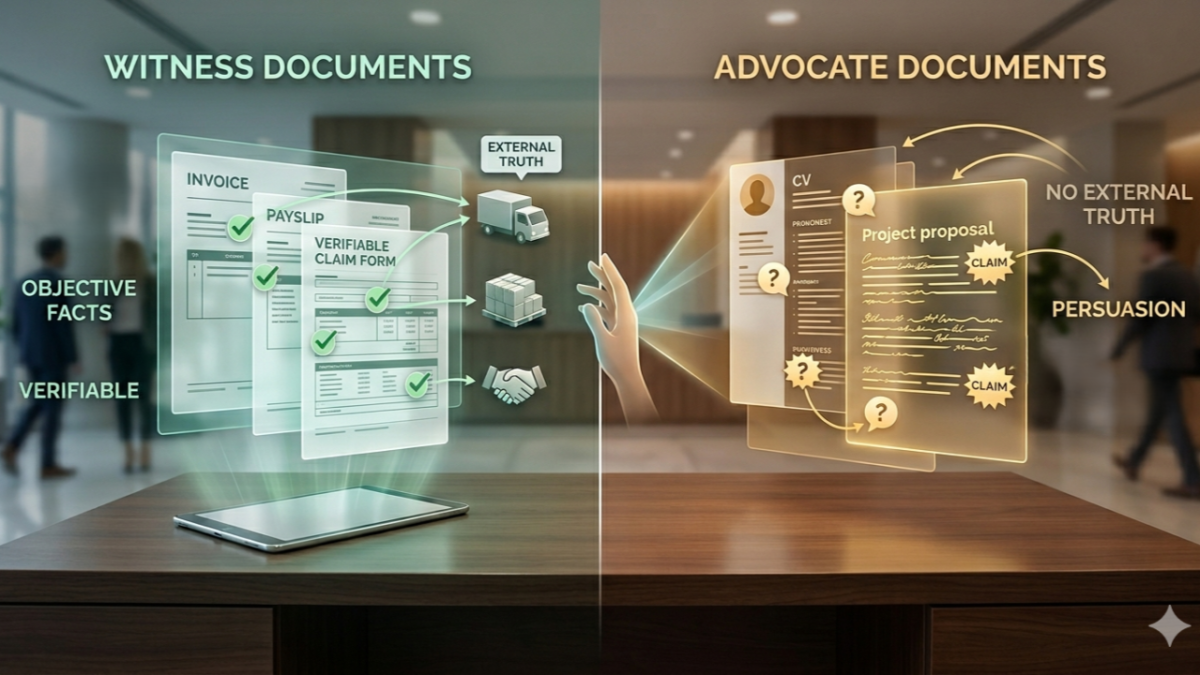
Document AI is a type of AI that enables reading and extracting information from documents. Like a clerk in a court, it extracts and records information, but it doesn't judge or interpret.For example, it extracts information from an invoice but doesn't judge if the prices on the invoice are too low or too high.To understand what Document AI can handle, you need to divide business documents into two distinct categories: Witnesses and Advocates.
Witness Documents
A witness document records a fact that exists independently of the document. The document's job is to be a faithful record of that fact and can be checked against something real.Here are a few examples:
- Payslips, verifiable against the payroll source system that produced them.
- Invoices, verifiable against the agreed terms, the goods delivered, and the purchase order.
- Medical records, verifiable against the underlying clinical events recorded in source systems.
- Insurance claims, verifiable against the policy and the underlying event.
If a document’s value lies strictly in the objective facts it contains, and those facts can be checked against an external truth, then the extracted result can be checked and validated in a defensible way.
Advocate Documents
Advocate documents make a case. They present the information that the creator wants you to see, because the document was authored to persuade.Document AI can extract data from these documents, in terms of dates, the claims, the keywords and the structure.This is the central distinction. Document AI can read an advocate document perfectly well. What it cannot do is verify what it reads, because there is nothing outside the document to check against.For example, a CV is generally tailored to a company or job description, having the goal that a candidate gets selected for the job. It lists facts that look objective, such as employment history and education, alongside claims like ten years of leadership experience, enthusiasm, diligence or technological savviness that cannot be verified from the document at all.
Conclusion
When evaluating Document AI tools, the first question to ask isn't about the technology. It's whether the document being processed has an external truth the result can be checked against.That single question decides whether the tool can be held to a standard of correctness at all.
29.05.2026