
ARTICLES
Large Language Models have changed how we work with information. They explain complex topics, summarise documents, generate code and help solve problems that used to take hours of research.
Yet whenever the discussion turns to AI in HR, I keep meeting the same assumption: if the model gets good enough, it will eventually replace rule-based systems, the ones that take a fixed set of inputs and always produce the same result.
I don't think that's where enterprise AI is heading. I think the opposite is true. The most reliable AI systems in regulated environments will pair those rule-based systems with LLMs, because the two solve different problems.
What an LLM actually does
A Large Language Model is a prediction engine. It does not retrieve the correct answer from a legal code or a payroll specification. It predicts the sequence of words most likely to follow your prompt, based on patterns learned from enormous amounts of text.
That makes LLMs remarkably capable. They explain legislation, summarise long documents, answer questions, draft reports and translate between languages. The common thread is that they generate language, and they do it well.
What they are not built to optimise for is producing the single authoritative explanation that a regulator, auditor or payroll specialist would treat as canonical. Most of the time, those two objectives are close enough. In regulated environments, they often are not.
What regulated environments expect
Payroll, pensions, taxation and accounting operate under a different standard. For a given set of facts, there is usually one outcome considered correct under legislation, regulation, contract and system specification. Organisations therefore expect more than a plausible answer. They expect identical inputs to produce identical outputs, calculations to be reproducible, decisions to be traceable, and results to remain consistent months or years later. In this world, consistency matters as much as correctness. That is not because regulators dislike AI. It is because governance requires reproducibility.
This is where the mismatch shows. For many regulated questions, there is no prompt that reliably produces the one explanation every lawyer, auditor, consultant and regulator would call definitive, because multiple valid explanations genuinely exist.
- A payroll consultant might explain a rule from the perspective of salary.
- A pension specialist might focus on pension legislation.
- A lawyer might cite the governing legal provisions.
- A tax expert might contrast tax law with social insurance law.
None of them is wrong. They approach the same truth from different angles. An LLM learns all of these explanations, and its job is to generate a good one, not to decide which one your organisation treats as authoritative.
A simple experiment
To see this in practice, I asked the same commercial LLM the same question five times, each time in a fresh conversation. The question was deliberately simple: "In Switzerland, why is child allowance not included in the pension premium basis?"
The model produced five different explanations, and none looked incorrect. But they differed. Some focused on the purpose of occupational pensions, others on the relationship with social-insured salary. Some framed child allowance as a statutory family benefit, another as a reimbursement of family costs. Some discussed taxation, others funding mechanisms. All reached essentially the same conclusion. None was the same.
Here is the part worth sitting with. This is not a weakness of the model. Ask five experts the same question, or one expert five times with no memory of the previous answers, and you get the same result: five valid explanations, none identical. The variation is a property of the question, not a defect of whoever answers it. The rule admits several true framings, so anything that explains it will vary. This isn't hallucination, and it isn't failure. It's exactly what LLMs are designed to do: generate plausible, contextually appropriate language. Nor is it a sampling artefact you can turn off. Lowering the temperature, the hyperparameter that controls the randomness and creativity of a model, makes a single prompt repeatable, but it simply forces the model to arbitrarily anchor to one perspective. It doesn't actually create a single definitive answer, because the underlying data still holds multiple truths.
And that is precisely the point. You would never accept a payroll expert computing a net salary five different ways and calling all five correct. Explanation tolerates variation; calculation does not. What a regulated process reproduces is not the explanation, it is the outcome, and outcomes come from deterministic rules, not from asking anyone, human or model, to re-derive them each time. For a conversational assistant, five explanations are fine. For an audited HR process, five outcomes are not. The problem was never correctness. It is reproducibility, and it lives in a different layer.
Rule-based systems, with LLMs
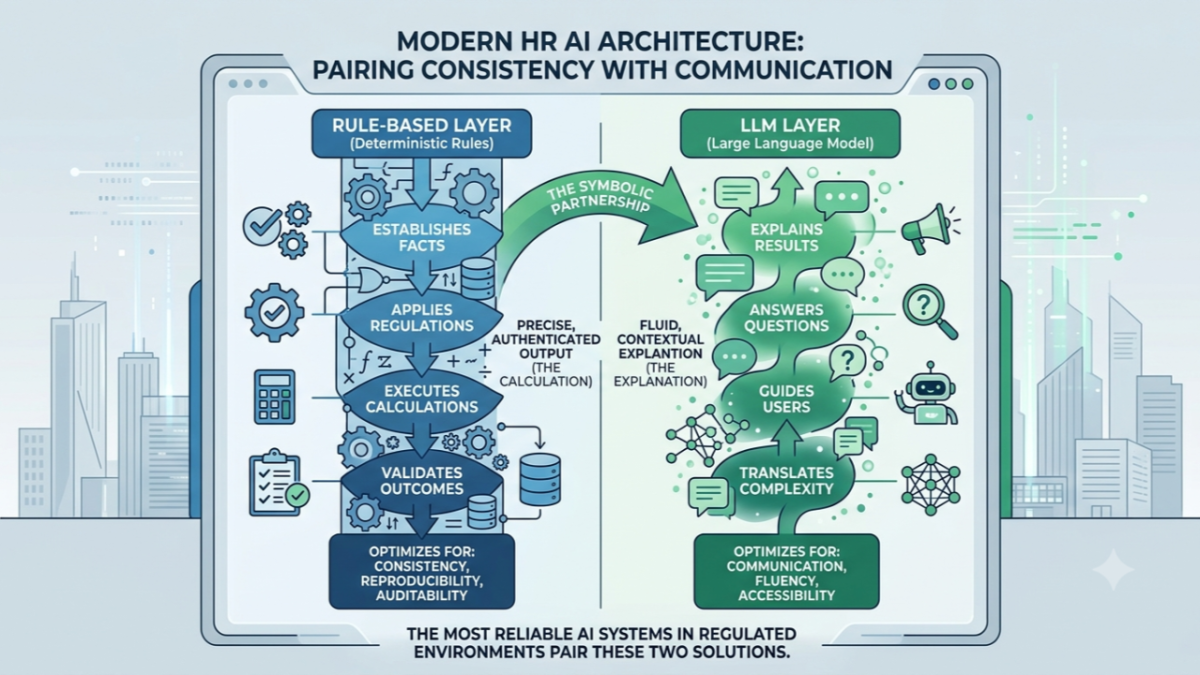
None of this convinces me that LLMs don't belong in HR. It convinces me they belong in a specific place. The future of enterprise HR AI is not rule-based systems or LLMs. It is rule-based systems with LLMs.
The rule-based layer establishes facts, applies regulations, executes calculations and validates outcomes, producing results that are reproducible and auditable. The LLM sits on top of that foundation. It explains those results, answers questions, guides users and turns complex regulation into language people can understand. The two fit together well precisely because they optimise for different things: rule-based systems optimise for consistency, LLMs acts as the fluent translator or user interface, and together they are more useful than either alone.
02.07.2026